


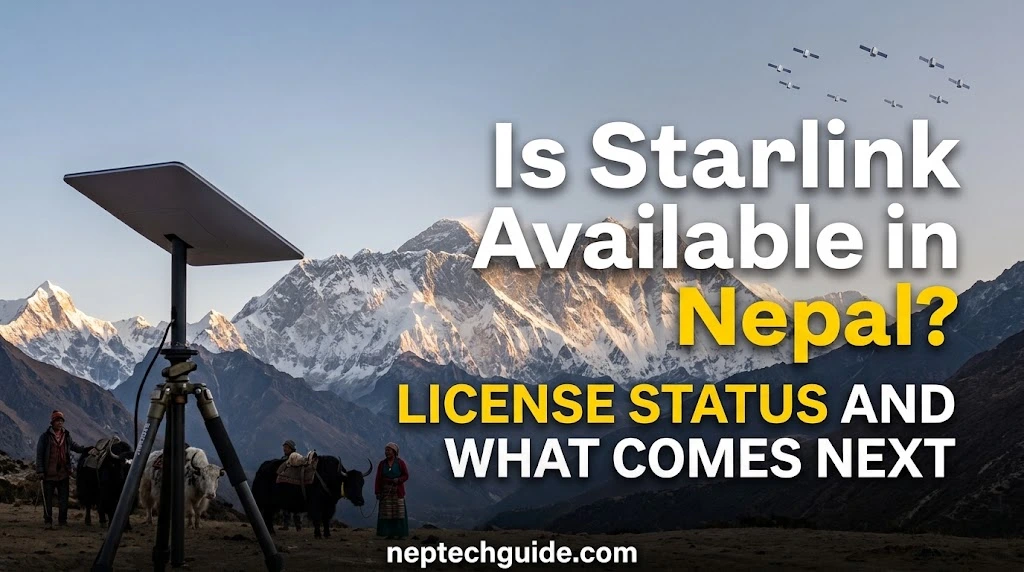
Nepal is one of the best places in the world to imagine satellite internet working. Mountain villages, trekking routes, and remote districts often have weak mobile coverage and no fiber. That is why “Starlink in Nepal” is one of the most searched tech questions in the country.
The short answer: Starlink is not officially available in Nepal as of September 2026. But the story is moving. This guide explains what happened in the 2026 license talks, why ownership rules are the main obstacle, what the new Bangladesh route means, whether you can legally use a Starlink dish, and what alternatives exist today.
Starlink in Nepal: Quick Facts
| Question | Answer (September 2026) |
| Is Starlink officially available? | No |
| Has a license been issued? | No license issued as of July 2026 reports |
| Starlink website status for Nepal | Service date unknown |
| Main obstacle | Foreign ownership limit in telecom law |
| Starlink’s condition | Wants 100 percent ownership of the local license |
| Nepal’s rule | Foreign companies can own up to 80 percent, 20 percent must be Nepali |
| Neighbours already served | Bhutan, Bangladesh, Sri Lanka |
| India | Granted Starlink a five-year commercial license |
What Is Starlink?
Starlink is a satellite internet service developed by SpaceX. It uses thousands of low Earth orbit (LEO) satellites that fly much closer to Earth than traditional communication satellites. This allows lower latency and higher speeds, making it suitable for video calls, streaming, and online work even in remote areas where cables cannot reach.
Users need a Starlink kit (dish and router) and a clear view of the sky.
Timeline of Starlink’s Efforts in Nepal
- Since 2022: Starlink has shown steady interest in the Nepali market and filed a license application with NTA.
- Earlier talks: SpaceX demonstrated the system to then Prime Minister KP Sharma Oli, who also held a virtual session with Elon Musk.
- May 2025: NTA warned against unlicensed satellite internet terminals operating at Everest Base Camp.
- June 1, 2026: Starlink director Rebecca Hunter met Communications Minister Dr. Bikram Timilsina in Kathmandu.
- June 2026: Visiting US Under Secretary of State Sarah Rogers said connectivity is a US priority in Nepal, while noting the decision is up to Nepal.
- July 2026: Bangladesh’s telecom regulator allowed Starlink to carry cross-border internet traffic, creating a possible technical path into Nepal.
Why Starlink Is Still Not Licensed
1. The 20 Percent Local Ownership Rule
Nepal’s telecom policy caps foreign ownership at 80 percent. The remaining 20 percent must be held by Nepali investors. Starlink operates with full ownership in its markets and has said approval could only work under a 100 percent Starlink-owned license.
2. Opposition From Local ISPs
Many local internet service providers oppose Starlink’s entry, citing fears of business loss and job cuts.
3. Policy and Security Questions
Governments in the region have raised issues around data security, spectrum, and digital sovereignty. These discussions take time.
Despite the hurdles, Minister Timilsina indicated that licensing would face no major obstacle within the prevailing law, and Starlink said it was talking to several Nepali service providers about partnerships. Starlink has also proposed investing around Rs 6 billion in Nepal.
The Bangladesh Route Explained
In July 2026, Bangladesh authorised Starlink to export bandwidth to neighbouring countries. Experts describe this as a “bent pipe with foreign anchors” structure. In simple terms:
| Step | What Happens |
| 1 | Internet bandwidth enters Bangladesh through submarine cables |
| 2 | Starlink gateways in Bangladesh send it to satellites |
| 3 | Satellites beam it down to user dishes in Nepal |
| 4 | Only the user terminal needs to be on Nepali soil |
Technically, this reduces the need for gateways or servers inside Nepal. Legally, however, Nepal’s government still has to approve the service. Without a license, the Bangladesh route does not make Starlink legal to use in Nepal.
Can You Buy and Use a Starlink Dish in Nepal?
Not legally at the moment. Operating an unlicensed satellite internet terminal can violate Nepal’s telecom regulations. NTA has already issued warnings about unlicensed terminals at Everest Base Camp. Importing a kit may also create customs problems.
| Risk | Possible Consequence |
| Unlicensed operation | Regulatory action by NTA |
| Customs import | Seizure or penalties |
| No local support | No warranty or service help |
| Account issues | Starlink may restrict service in unsupported regions |
Wait for an official launch before spending money on hardware.
How Much Could Starlink Cost in Nepal?
No official Nepali pricing exists. Reports suggest that likely package prices may be out of reach for average households when compared with fiber plans, especially once hardware, taxes, and dollar exchange rates are included. Payment for foreign services is also limited for many Nepalis. Learn how international payments work in our dollar card guide for Nepal.
In cities, fiber is likely to remain far cheaper. Compare current plans in our best internet packages in Nepal 2026 guide.
Who Would Benefit Most From Starlink?
| User Group | Benefit |
| Remote villages in mountain districts | Internet where fiber and 4G are weak |
| Trekking lodges and tourism businesses | Reliable connectivity for guests |
| Disaster response teams | Fast setup after floods and landslides |
| Schools and health posts | Online learning and telemedicine |
| Mountaineering expeditions | Communication at high altitude |
The value of satellite connectivity became clear during the Bhotekoshi floods in September 2026, when Ncell started satellite-powered connectivity in affected areas and DishHome provided satellite communication to support rescue efforts.
Satellite Internet Alternatives in Nepal Today
- Kacific: Already available in some northern districts through a local licensee.
- Operator satellite links: Ntc, Ncell, and DishHome use satellite backhaul in hard-to-reach or disaster-hit areas.
- 4G expansion: The government has pushed 4G to more local levels, and Ntc continues expanding coverage in remote places.
- Wireless broadband: Ntc Namaste WiFi uses 4G routers where fiber is unavailable.
For the future of mobile speeds, see our update on 5G in Nepal.
What Would Need to Happen for Starlink to Launch?
- The government changes or makes an exception to the foreign ownership rule, or Starlink accepts a local partner structure.
- NTA issues a license with clear conditions on security and data.
- Starlink sets up local registration, payment, and support.
- Starlink updates its coverage map to show Nepal as available.
Starlink vs Fiber vs 4G: Realistic Comparison for Nepal
| Factor | Starlink (if licensed) | Fiber Broadband | 4G Mobile Data |
| Availability in remote hills | Excellent with clear sky | Limited | Improving but patchy |
| Setup | Dish and router installation | ISP cable installation | SIM card only |
| Weather impact | Heavy rain or snow can affect signal | Minimal | Moderate |
| Upfront cost | Hardware likely expensive | Low with annual plans | Very low |
| Monthly cost | Likely higher than fiber | Low | Depends on usage |
| Best for | Remote lodges, rescue teams, isolated villages | Urban homes and offices | Mobile users |
For urban users, satellite internet is unlikely to replace fiber. Its real value lies in places where laying cable is difficult or uneconomical, such as high mountain settlements, border areas, and seasonal trekking routes.
What Nepali ISPs Are Doing Meanwhile
Local ISPs continue expanding fiber into new districts. WorldLink, for instance, reports service in more than 74 districts, including Jumla in Karnali. Operators are also using satellite links as backup in disaster-prone regions.
Conclusion
Starlink could transform connectivity in Nepal’s remote regions, but for now it remains a policy question rather than a technology one. Avoid buying unlicensed hardware, rely on fiber and 4G where available, and follow official NTA and ministry announcements for real updates.
Frequently Asked Questions
1. Is Starlink available in Nepal right now?
No. As of September 2026, Starlink has not received a license to operate in Nepal, and its coverage map lists Nepal with an unknown service date.
2. Why has Nepal not approved Starlink?
The main issue is ownership. Nepali law requires 20 percent local ownership in telecom companies, while Starlink wants 100 percent ownership. Local ISPs have also opposed its entry.
3. Can I legally import and use a Starlink dish in Nepal?
Not at present. Using an unlicensed satellite terminal can breach telecom regulations, and NTA has warned against such devices.
4. Does Bangladesh’s approval mean Starlink will work in Nepal?
It creates a technical path, but Nepal’s government must still approve the service before it can be legally used.
5. When will Starlink launch in Nepal?
There is no confirmed date. It depends on policy decisions and license approval.
6. Is satellite internet already used in Nepal?
Yes, in limited ways. Kacific service is available in some northern districts through a local licensee, and operators use satellite links for connectivity in hard-to-reach and disaster-hit areas.








2 Comments
[…] Is Starlink Available in Nepal? 2026 License Status and What Comes Next […]
[…] Is Starlink Available in Nepal? 2026 License Status and What Comes Next […]